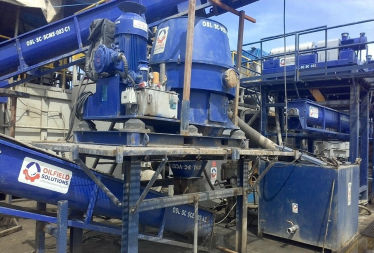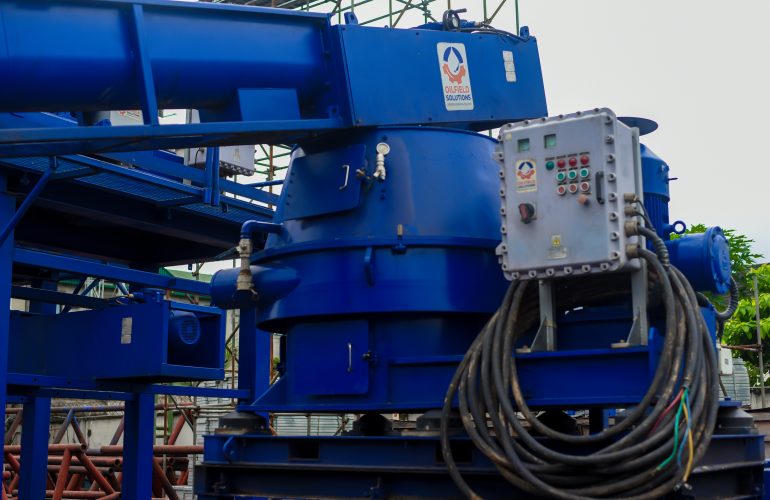

The secondary stage of Solids Control is a critical aspect of drilling operations, aimed at managing and disposing of finer drill cuttings and maintaining the properties of drilling fluid. This process ensures the fluid remains within desired parameters, reducing costs and environmental impact. The process of secondary solids control involves a series of equipment and techniques designed to separate solids from the drilling fluid, ensuring optimal drilling conditions.
At Oilfield Solutions Ltd, we carry out secondary solids control services, aimed at removing finer solids and processing drill cuttings for superior fluid quality. This involves the use of specific equipment in secondary solids control that operates in a multi-stage process that separates and removes drilled solids from the drilling fluid, preserving its quality and preventing equipment wear, wellbore instability, and environmental contamination.
Let’s Explore Some of This Vital Equipment:
Centrifuges: they play a pivotal role in the secondary stage of solids control, enhancing the removal of fine particles from the drilling fluid that primary equipment, such as shale shakers, cannot efficiently separate. It operates on the principle of centrifugal force. They consist of a rotating bowl and a scroll conveyor. As the drilling fluid enters the centrifuge, the high rotational speed generates centrifugal forces that push the denser solid particles outward to the bowl’s perimeter. The lighter liquid phase moves towards the center and exits through an overflow discharge.
Centrifuges complement other secondary and primary solids control equipment, such as desanders, desilters, and mud cleaners. After primary separation by shale shakers and secondary separation by hydrocyclones, the centrifuge provides a final cleaning step, ensuring optimal drilling fluid quality.
Variable Frequency Drives (VFDs): Variable Frequency Drives (VFDs) are essential in modern solids control systems, providing precise control over the operation of equipment such as centrifuges, pumps, and conveyors. VFDs adjust the motor speed and torque, optimizing the performance and efficiency of solids control processes. The VFD integrates with centrifuges and conveyors, allowing for the precise control of the centrifuge’s bowl and scroll speeds, optimizing the separation process for different types of drilling fluids and solids. By adjusting conveyor speeds, VFDs ensure the efficient transport of separated solids, preventing bottlenecks and ensuring smooth operation.
Conveyors: These are crucial for the efficient transport and handling of separated solids in the solids control system. They ensure the smooth transfer of solids from one stage of the process to another, preventing bottlenecks and maintaining a continuous flow. They can be of various types, including screw conveyors, belt conveyors, and bucket elevators, depending on the specific application.
Vertical Cutting Dryers: Vertical cutting dryers are specialised equipment used in the secondary stage of solids control to reduce the oil content in cuttings. They enhance the recovery of drilling fluids and ensure compliance with environmental regulations. These machines reduce the volume and weight of drill cuttings by removing moisture. The cuttings are fed into a vertical chamber, where they are subjected to hot air, reducing their moisture content. The cleaned cuttings are then discharged, and the recovered fluid is returned to the active mud system.
CONCLUSION
Centrifuges, Variable Frequency Drives (VFDs), Conveyors, and Vertical cutting dryers play vital roles in the secondary stage of solids control, ensuring the efficient transport and handling of solids and maximising the recovery of drilling fluids. At Oilfield Solutions Limited, our team of experts integrates these technologies to optimise your drilling operations, achieving higher efficiency, better cost savings, and environmental compliance, which contributes to the overall success of the drilling project.
For more information, contact us at bdm@oilfieldsolutions-ng.com